

Is EMDR Therapy Covered by Insurance? What Texas Clients Should Know
Key Takeaways:
Most plans that cover outpatient therapy also cover EMDR. It's billed as regular psychotherapy (CPT 90834 or 90837), with no separate EMDR code.
Your counselor needs to document a diagnosis. PTSD is the clearest case, and other conditions may face a closer medical-necessity review.
Texas parity law (HB 10) means your plan can't put tighter limits on therapy than on medical care, though it doesn't force a plan to cover every service.
Your deductible, copay or coinsurance, session limits, prior authorization and network status determine what you actually pay. Ask your insurer the seven questions before you book.
If a claim is denied or your counselor is out of network, you can appeal, request a superbill, use an HSA or FSA, or pay out of pocket.
You finally feel ready to work through something painful, and then a practical worry shows up: is EMDR therapy covered by insurance? Between deductibles and billing codes, it's easy to feel stuck before you even book a first session. The good news is that most plans that cover outpatient therapy also cover EMDR, and a short call to your insurer can tell you what you'll pay.
This guide explains how EMDR therapy insurance coverage works in Texas, what your plan may ask for, and how to check your benefits before your first appointment. Our counselors offer EMDR therapy online across Texas, and we're in-network with many major insurance plans, so we hear this question often.
Does Insurance Cover EMDR Therapy?
Usually, yes. EMDR doesn't have its own billing code. Therapists bill it as individual psychotherapy, most often under CPT code 90834 for a session of about 45 minutes (38 to 52 minutes) or 90837 for a session of 53 minutes or longer. Your insurer sees a therapy session and a diagnosis, not a line item that says EMDR. So if your plan covers outpatient mental health care, insurance for EMDR therapy generally works the same way it does for talk therapy.
There's one condition. Insurance pays for treatment of a diagnosed condition, so your counselor will need to document a diagnosis. PTSD is the most straightforward case, and Aetna's clinical policy, for example, treats EMDR as medically necessary for PTSD. For anxiety, depression, or grief, a plan may ask a few more questions about medical necessity before approving sessions. It's fair to ask your counselor how they document and share diagnoses with your insurer.
EMDR Insurance Coverage in Texas: What State Law Adds

Texas passed a mental health parity law in 2017 as House Bill 10. It says a health plan that covers mental health care must provide those benefits on the same terms as medical and surgical benefits. In plain words, your plan shouldn't place tighter limits on therapy than on a doctor visit. The Texas Department of Insurance enforces these Texas mental health parity rules for fully insured plans issued or renewed since January 1, 2018.
If your employer pays claims itself, which is called a self-funded plan, federal parity rules apply instead of state rules. Your HR team can tell you which type of plan you have. Either way, parity protects how benefits are applied. It doesn't require every plan to cover every service, so you still need to confirm your own benefits.
Which Insurance Plans Cover EMDR at Know Your Worth?
Know Your Worth Counseling and Wellness is in-network with United Healthcare/Optum, Aetna, Oscar Health, Oxford, Cigna/Evernorth, BCBS/Anthem, Baylor Scott & White, Magellan, and Curative. Network status can vary by counselor, so confirm that the counselor you want takes your plan. Our rates and insurance page lists the current plans and self-pay rates.
Several of our professional counselors are trained in EMDR: Amanda Sieg, Stephanie Dall, Natalie Johnson, Mandy Melton, Sally Densk, Michelle Gelnaw, and Brianne Godlevski. All sessions are virtual, so you can work with an EMDR counselor from home anywhere in Texas.
Telehealth is billed with the same psychotherapy codes plus a telehealth modifier, and most plans that cover in-person therapy also cover video sessions. A few plans have their own telehealth rules, so ask about virtual visits when you call.
What Affects Your Out-of-Pocket Cost
Even when EMDR is covered, "covered" doesn't mean free. Five parts of your plan decide what you pay.
Your deductible is what you pay before insurance starts sharing the cost. After that, you pay a copay (a flat fee) or coinsurance (a percentage) for each session. Some plans cap the number of therapy visits each year, and some want prior authorization before treatment starts or after a set number of visits. In-network counselors usually cost less than out-of-network ones.
Session length can matter too. A standard therapy session runs about 45 minutes, while EMDR can work better in longer sessions. Insurers pay based on the billing code tied to session time, so ask your counselor how long sessions usually run and which code they bill.
Questions to Ask Your Insurance Company Before Your First EMDR Session
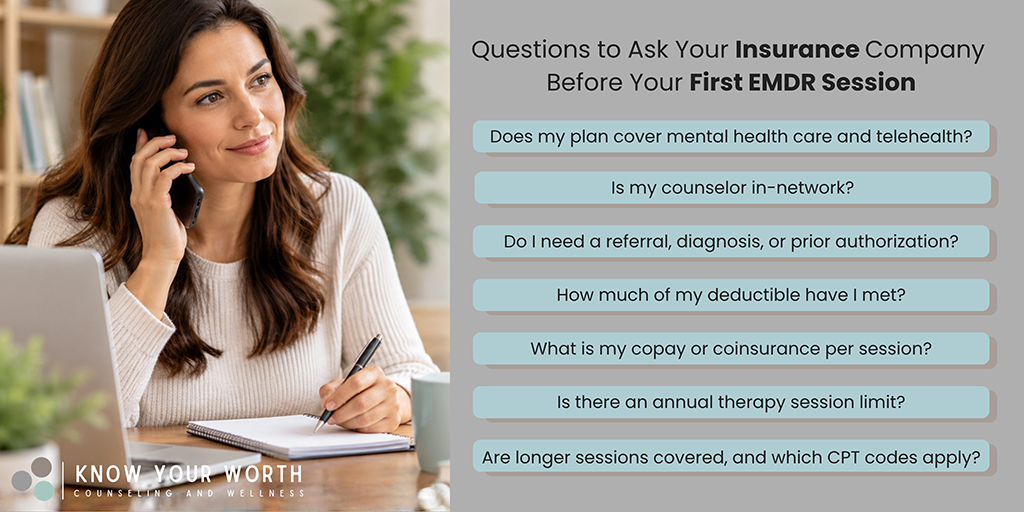
Before you book, call the number on your insurance card. If you're new to this, the basics of using insurance for therapy in Texas apply to EMDR too. Here's what to ask:
Do I have outpatient mental health benefits, and do they include telehealth?
Is my counselor in network for my specific plan?
Do I need a referral, a diagnosis on file, or prior authorization?
What is my deductible, and how much of it have I met?
What will I pay per session after that, as a copay or coinsurance?
Is there a limit on the number of therapy sessions per year?
Does my plan cover longer sessions, and which CPT codes does it pay for?
Write down the representative's name and the call reference number. If a claim is questioned later, that note helps. When you upload your insurance card with your intake paperwork, our team can also help you check your average.
What To Do if a Claim is Denied or You're Out of Network
A denial rarely means your insurer rejects EMDR itself. Most often it's a paperwork issue, like a missing authorization or a network mismatch. Read the explanation of benefits to see the stated reason, then ask your counselor for any records your insurer needs. You can appeal the decision, and in some cases you can ask for an external review.
If your counselor isn't in network with your plan, ask whether your plan has out-of-network benefits. A superbill, which is an itemized receipt, may let you submit a claim for partial reimbursement, and we provide superbills when you ask. Reimbursement depends on your plan, so nothing is guaranteed.
You can also pay your share with pre-tax dollars. Counseling is often an eligible expense, so check your HSA or FSA rules. We also welcome self-pay clients if you'd rather not use insurance.
What about Medicare and Medicaid?
Medicare Part B and Texas Medicaid generally cover outpatient psychotherapy from providers enrolled in those programs, and EMDR falls under that coverage. Know Your Worth doesn't accept Medicare or Medicaid at this time. If that's your coverage, ask your plan for a directory of enrolled EMDR counselors. You're also welcome to reach out to us with questions.
Final Thoughts
Insurance questions keep a lot of people from starting trauma therapy. The paperwork feels confusing, and it's hard to ask for help when you're already carrying something heavy. If you've been asking yourself, " Is EMDR therapy covered by insurance, you're not alone. Having EMDR therapy covered by insurance is realistic for many Texans.
Start by calling the number on your insurance card and asking the questions above. Write down the answers, then choose an in-network counselor so you know your cost before your first session.
Confirm Your EMDR Therapy Insurance Coverage Today
Healing from trauma shouldn't wait on a billing question. Know Your Worth Counseling and Wellness offers virtual EMDR therapy across Texas with counselors who work with many major insurance plans. We'll help you understand your benefits so you can focus on feeling better.
Ready to start EMDR therapy? Contact us today to schedule an appointment.
FAQs
Is EMDR therapy covered by insurance in Texas?
In most cases, yes. If your plan covers outpatient mental health care, it usually covers EMDR billed as psychotherapy, as long as your counselor documents a diagnosis. Your deductible, copay or coinsurance, and any session limits still apply, so confirm your benefits before you book.
Does insurance cover EMDR therapy for anxiety or depression?
It can. PTSD is the clearest fit for EMDR coverage, but many plans also pay for sessions that treat anxiety, depression, or grief when your counselor documents the diagnosis and why treatment is needed. Some plans review conditions other than PTSD more closely, so ask your insurer how it handles them.
Is online EMDR therapy covered by insurance?
Most plans that cover in-person therapy also cover video sessions, billed with the same psychotherapy codes and a telehealth modifier. Plan rules differ, so ask whether your plan covers virtual visits. All of our EMDR sessions are virtual.
How is EMDR billed to insurance?
As individual psychotherapy. Counselors use CPT 90834 for sessions of 38 to 52 minutes and CPT 90837 for sessions of 53 minutes or longer. There's no separate EMDR code.
What if my plan doesn't cover EMDR?
Ask about out-of-network benefits and request a superbill, check whether you can use an HSA or FSA, or consider self-pay. Our team can answer questions about superbills and self-pay rates.
